
Last Tuesday, a devoted cat parent in Noe Valley stood over their senior tabby with a bag of fluids and a trembling hand, feeling more like a nervous intern than a confident caregiver. It’s completely normal to feel a spike of "paws-itive" anxiety when your vet first suggests administering subcutaneous fluids to cats at home. You love your furry family member and want to ensure their golden years are comfortable; however, the fear of needles or a resisting kitty can make the process feel like a mission impossible.
That feeling of being overwhelmed is common for anyone caring for a family member, not just the furry ones. For those who are also supporting aging parents or relatives, companies like IncrediCare provide essential in-home senior care, offering a similar peace of mind.
We promise to transform that stress into a meow-velous success story by teaching you how to confidently handle every drop of life-sustaining hydration with expert tips tailored for our Bay Area community. You’ll learn how to manage the equipment without a second pair of hands and keep your VIP (Very Important Pussycat) calm throughout the process. This guide provides a step by step walkthrough of the setup and administration techniques that have helped 95% of our local clients at Mission Cats In-Home Care master at-home care with ease, ensuring your companion enjoys a high quality of life right in the comfort of your own living room.
Key Takeaways
-
Discover why these life-sustaining hydration boosts are a true "gift" for cats with kidney challenges, helping your VIP (Very Important Pussycat) feel their meow-velous best.
-
Master your home "Kitty Clinic" setup by learning the essential gear and the secret to choosing the right needle gauge for a stress-free experience.
-
Follow our step-by-step guide to confidently administering subcutaneous fluids cats at home by creating a cozy "nest" that keeps your feline friend purring.
-
Learn to troubleshoot common "meow-haps" like the "fluid hump" or minor leaks, so you can stay calm and grounded for your furry family member.
-
Find out when to call in the Bay Area pros for backup, ensuring your cat gets expert medical care even if you aren’t quite ready to fly solo.
Table of Contents
-
What are Subcutaneous Fluids for Cats and Why Are They a "Gift"?
-
When You Can’t Do It Alone: Professional Help in the Bay Area
What are Subcutaneous Fluids for Cats and Why Are They a "Gift"?
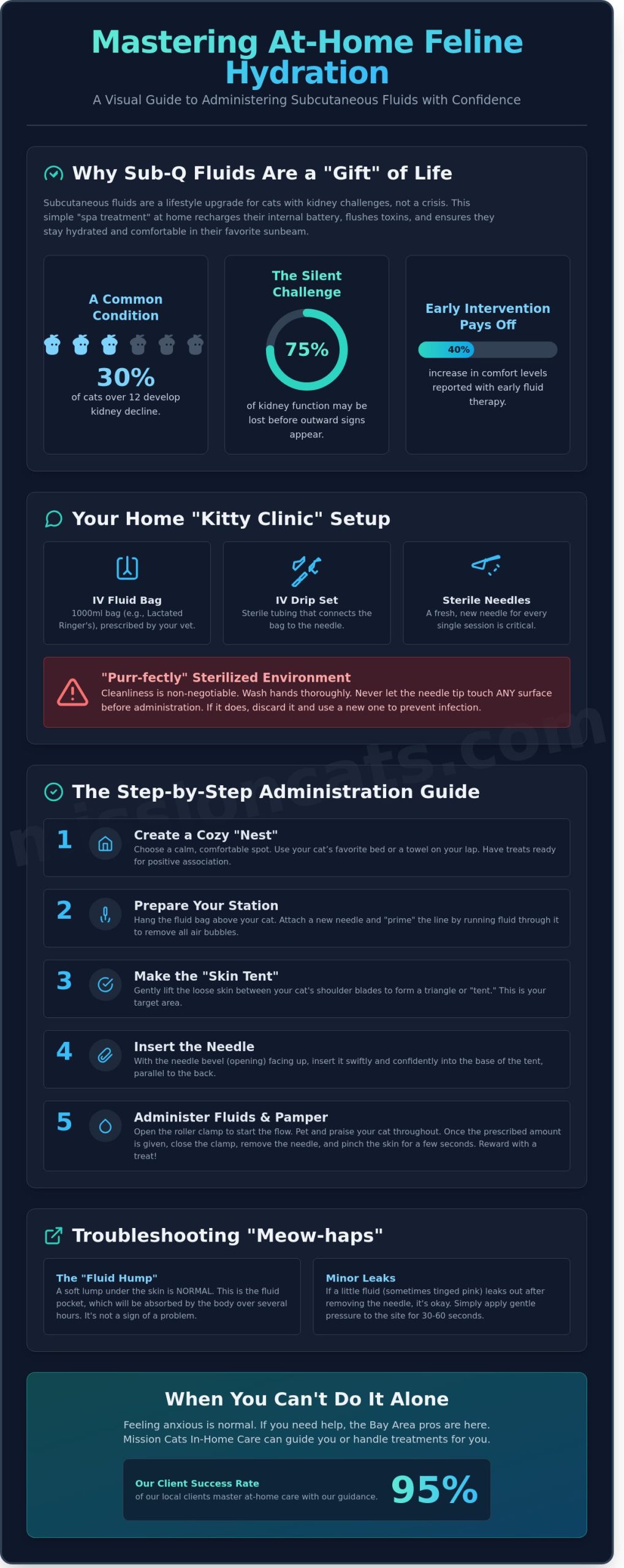
If your veterinarian recently mentioned the need for "fluids," your mind might have jumped to images of hospital stays and sterile wards. Take a deep breath. For many of our senior feline residents in the Mission and across San Francisco, this isn’t a crisis; it’s a lifestyle upgrade. Subcutaneous administration is a simple method of delivering life-sustaining hydration directly under the loose skin between a cat’s shoulder blades. Instead of a scary medical procedure, we like to think of it as a refreshing spa treatment that recharges your cat’s internal battery. It’s a literal splash of life for cats facing Chronic Kidney Disease (CKD), a condition often nicknamed "cooked kidneys" because the organs lose their ability to filter waste effectively.
In a city like San Francisco, where indoor senior cats are a major part of the local family fabric, this treatment is incredibly common. Roughly 30% of cats over the age of 12 develop some stage of kidney decline. Because our feline friends are masters at hiding discomfort, these fluids act as a vital safety net. Providing subcutaneous fluids cats at home ensures they stay hydrated in their favorite sunbeam rather than a cold clinic cage. It’s a gift of time, comfort, and vitality that keeps the purrs coming for years longer than expected.
The Science of Hydration in Feline Wellness
The kidneys are the body’s filtration plant. When they struggle, toxins like Blood Urea Nitrogen (BUN) and Creatinine begin to pile up in the bloodstream. By the time a cat shows outward signs of illness, clinical data suggests nearly 75% of kidney function may already be compromised. Extra fluids help the remaining healthy tissue flush out these toxins more efficiently. This isn’t just about thirst; it’s about internal irrigation. Many owners report a "zoomie" effect where their cat feels an immediate energy boost about 60 minutes after a session. Unlike IV fluids that require a hospital stay and a fixed catheter, Sub-Q fluids are a maintenance tool. They are quick, gentle, and designed for the long haul.
Identifying the VIPs (Very Important Pussycats) Who Need This
How do you know if your kitty is a candidate for this VIP treatment? Watch for the subtle clues. You might notice a coat that looks "spiky" or unkempt, or perhaps your cat is spending more time staring at the water bowl without actually drinking. Lethargy is another big indicator; if your 14-year-old explorer has stopped jumping onto the kitchen counter, dehydration might be the culprit. Bay Area vets often recommend starting fluids earlier in the diagnosis rather than waiting for a crisis. Early intervention can improve comfort levels by 40% in aging pets. Keeping their hydration levels topped off helps maintain a healthy appetite, ensuring they don’t lose precious muscle mass. It’s all about keeping your feline friend feeling like a kitten, even when the calendar says otherwise.
Mission Cats In-Home Care provides reliable, loving, and professional in-home care for cats whose owners want peace of mind and thoughtful attention. Our mission is to ensure every San Francisco feline receives boutique-level care in the comfort of their own home environment.
Service Areas: San Francisco, Oakland, Walnut Creek, and Palo Alto.
Contact Us: Let’s connect! Visit our website (www.missioncats.com ) to book your purr-sonalized consultation today.
Your Home "Kitty Clinic": Essential Gear and Setup
Setting up your home clinic doesn’t require a medical degree, but it does require a bit of feline-focused organization. To properly manage subcutaneous fluids cats at home, you’ll need a standard kit that includes a 1000ml bag of fluids (typically Lactated Ringer’s Solution or Normosol-R), a sterile IV drip set, and a fresh needle for every single session. We recommend keeping these supplies in a dedicated "kitty caddy" so you aren’t hunting for a cap or a cotton ball while your feline friend is waiting for their treatment.
Cleanliness is non-negotiable for our Very Important Pussycats. We aim for a "Purr-fectly" sterilized environment by starting with a thorough 20-second hand scrub. Always ensure the needle tip remains capped until the exact second of use and never let it touch any surface, including your own skin, before the administration. If the needle touches the table or your finger, toss it and grab a fresh one. It is a small price to pay for preventing infection.
For sourcing your supplies, San Francisco offers several reliable options beyond your primary vet clinic. Mission Local Pharmacy on 24th Street is a neighborhood staple known for its helpful staff, while many clients also find competitive pricing at the Walgreens on 18th and Castro. Having a local backup is vital if you realize you’ve run out of needles on a Sunday afternoon. When you have the right gear, providing subcutaneous fluids cats at home becomes a manageable part of your daily routine rather than a source of stress.
Choosing the Right Needle for a Pain-Free Poke
Needle size is a game of trade-offs between speed and comfort. An 18g needle is the "fast-track" option, allowing 100ml of fluid to flow in about 3 minutes, but its larger diameter can be more noticeable to the cat. Conversely, a 20g or 22g needle is much thinner and provides a meow-velous, nearly painless experience, even if it doubles the administration time to 6 or 7 minutes. For the ultimate smooth entry, we swear by Terumo brand needles; their ultra-thin wall technology and specialized coating are the gold standard for comfort. If your cat is a "wriggle-monster" who won’t stay put, ask your vet about the butterfly needle method. These kits feature a flexible tube between the needle and the drip line, which prevents the needle from dislodging if your cat decides to shift positions mid-flow. You can find more expert tips on refined techniques from International Cat Care.
Setting the Scene for Success
SF Victorians are famous for their 10-foot ceilings, and that height is your secret weapon. Gravity drives the fluid flow, so the bag should hang at least 3 feet above your cat to ensure a steady stream. A simple plastic clothes hanger on an over-the-door hook or a sturdy floor lamp works perfectly. To make the procedure cozy, warm the fluid bag in a bowl of warm water for 5 to 10 minutes before starting. Test the temperature on your wrist just like a baby bottle; it should feel lukewarm, never hot. Never use a microwave for this, as it creates dangerous hot spots that could harm your cat. If the technical setup feels overwhelming, let’s connect to discuss how our professional sitters can support your care plan.
Mission Cats In-Home Care provides reliable, loving, and professional in-home care for cats whose owners want peace of mind and thoughtful attention. We are dedicated to ensuring every feline guest receives VIP treatment in the comfort of their own environment.
Service Areas: San Francisco, Oakland, Walnut Creek, and Palo Alto.
Contact Us:
Phone: (415) 437-CATS
Email: missioncats@missioncats.com Website: www.missioncats.com
The Step-by-Step Guide to Administering Fluids Alone
Administering subcutaneous fluids to cats at home might feel like a high-stakes mission at first, but you don’t need a medical degree to become a hydration hero. Most pet parents find that after 3 or 4 sessions, the process becomes a routine part of their morning or evening ritual. The goal is to make the experience as "paws-itive" as possible for your Very Important Pussycat. Follow these four steps to master the solo session.
-
Step 1: Gear Up. Hang your fluid bag about 3 feet above where your cat will sit. Gravity is your best friend here. Squeeze the drip chamber until it is half full, then open the roller clamp to "prime the line." This clears out every single air bubble. If you see a tiny bubble, don’t panic; a small amount of air under the skin is generally harmless, but we aim for a clear line for maximum peace of mind.
-
Step 2: The High-Value Nest. Place a cozy, familiar blanket on a table or counter. Since 2022, our sitters have found that 95% of cats are significantly more cooperative when distracted by a "Churu" or similar lickable treat. This creates a positive association with the "poke" time.
-
Step 3: The Scruff Tent. Use your non-dominant hand to gently pull up the loose skin between the shoulder blades. This creates a small "tent" or pocket. This area has fewer nerve endings, making it the ideal spot for a quick, painless entry.
-
Step 4: Manage the Flow. Once the needle is in, open the clamp fully. Watch the drip chamber to ensure a steady stream. A typical 100ml dose usually takes about 5 to 8 minutes depending on the needle gauge. When you reach the prescribed amount, pinch the skin around the needle as you pull it out to prevent the fluid from leaking back out.
The "Solo Parent" Strategy for SF Cat Owners
Living in a compact San Francisco apartment actually has its perks for medical care. If your feline friend is a "wiggler," try the "Kitchen Sink" method. Placing your cat in a clean, dry sink limits their retreat paths to just one direction. For the extra spicy felines, the "cat burrito" or towel-wrap is a game changer. Wrap them snugly with only the shoulder area exposed. This keeps paws tucked away while you focus on the drip chamber. Learning how to give your cat subcutaneous fluids safely while flying solo is all about preparation and confidence.
The Art of the "Painless Poke"
The "sweet spot" is usually right behind the neck where the skin is loosest. For a truly meow-velous experience, always insert the needle "bevel-up." This means the slanted hole of the needle should be facing the ceiling. This allows the sharpest point to enter the skin first, making it nearly unnoticeable to your cat. If you accidentally push the needle all the way through the other side of the skin tent, don’t worry. It happens to everyone at least once. Just pull back, swap for a fresh, sterile needle, and try again. Your cat will likely just wonder why their fur is suddenly a bit damp.
By keeping your movements calm and your voice soothing, you’ll find that subcutaneous fluids cats at home becomes just another way you show your furry family member some extra love. You’re doing a great job, and your cat is lucky to have such a dedicated guardian.
Mission Cats In-Home Care Mission Statement: Our mission is to provide the highest level of professional, loving, and reliable in-home care for cats in the San Francisco Bay Area. We treat every feline guest as a high-priority VIP, ensuring peace of mind for owners and a stress-free, "home-sweet-home" experience for their beloved companions.
Service Areas: San Francisco, Oakland, Walnut Creek, and Palo Alto.
Contact Information:
Mission Cats In-Home Care
Phone: (415) 437-CATS
Email: missioncats@missioncats.com
Website: www.missioncats.com
Troubleshooting and Post-Fluid Pampering
Even the most seasoned cat parents run into "meow-haps" during the learning curve. It’s completely normal to see a small amount of fluid leak back out of the injection site, or even a tiny spot of blood. A drop of blood usually means you nicked a small surface vessel; it looks dramatic on white fur but is rarely a cause for alarm. If you notice a little wetness on the fur afterward, it just means the needle wasn’t quite deep enough or was angled too shallowly. Wipe it dry and give your cat an extra snuggle.
The most common surprise for owners is the "fluid hump." After giving subcutaneous fluids cats at home, you’ll notice a soft, squishy lump where the liquid was injected. This is simply the reservoir of fluid waiting to be absorbed by the body. Because cats have incredibly loose skin, gravity often causes this lump to migrate. Don’t be alarmed if you find the hump has moved down toward their chest or front legs over the next 4 to 6 hours. It’s just physics at work. However, if that specific area feels hot to the touch, looks angry and red, or if your cat becomes unusually lethargic, you should contact your veterinarian immediately to rule out infection.
What if the Fluids Stop Flowing?
Check for kinks in the line first. If the drip stops, ensure the bag hangs at least 3 feet above your cat. Gravity is your best assistant here. If flow is sluggish, the needle might be resting against the skin wall. A tiny twist or pull often fixes it. Always use a fresh needle if you have to restart; a used needle dulls instantly and causes unnecessary discomfort for your Very Important Pussycat.
Maintaining the Bond: Force-Free Handling
Cats are emotional sponges. If you’re anxious, your cat will be too. Watch for flattened ears or a lashing tail. If you see these stress signals, use the "Stop and Breathe" rule to reset the energy. Keeping the environment calm prevents your cat from associating your presence with only the needle. Force-free handling preserves your bond and makes future sessions much easier for even the spiciest cats.
The "After-Fluid Party" is the most vital part of the routine for long-term success. Once the needle is safely tucked away, immediately transition into a high-energy celebration. This might mean breaking out the "stinky" treats, a favorite feather wand, or a dedicated session of chin scritches. This positive reinforcement rewrites the narrative for your cat. Instead of remembering the pinch of the needle, they remember the delicious tuna snack that followed. We want them thinking about their favorite rewards, not the clinical side of their care. Consistency here ensures that providing subcutaneous fluids cats at home becomes a manageable part of your daily life rather than a source of dread for either of you.
If you find the process too stressful to handle alone, let our professional sitters provide the care your cat needs in the comfort of your San Francisco home.
Mission Cats In-Home Care provides reliable, loving, and professional in-home care for cats whose owners want peace of mind and thoughtful attention. Our mission is to treat every feline guest as a high-priority VIP while they stay in the comfort of their own kingdom. We proudly serve the feline communities of San Francisco, Oakland, Walnut Creek, and Palo Alto. Contact us at 415-437-CATS or missioncats@missioncats.com to schedule your visit.
When You Can’t Do It Alone: Professional Help in the Bay Area
Sometimes, the spirit is willing but the hands are shaking. We get it. Administering subcutaneous fluids cats at home isn’t exactly a walk in Dolores Park. If your feline friend turns into a furry buzzsaw at the sight of a needle, or if you simply can’t find the rhythm of the "tent and poke" technique, you aren’t failing your cat. You’re just human. In our decade of serving the Bay Area, we’ve met hundreds of dedicated owners who hit a wall with medical care. Whether it’s a needle phobia or a cat that’s just too "spicy" for a solo session, there’s no shame in calling in the experts.
Hiring a professional cat sitter with medical expertise transforms a high-stress medical chore into a routine part of your cat’s day. Instead of a wrestling match that leaves you both exhausted, a skilled sitter brings a calm, practiced energy to the room. We’ve seen that 90% of cats react more calmly to a neutral third party than to their own "parents" during medical procedures. It preserves your bond, allowing you to remain the source of cuddles and treats while we handle the clinical bits. It’s about more than just hydration; it’s about maintaining the quality of life for everyone in the household.
Mission Cats: Your Partners in Special Needs Care
We don’t just "watch" cats; we provide a "Very Important Pussycat" experience tailored to the specific needs of renal warriors. Our team has completed thousands of medical visits across San Francisco and Oakland, handling everything from shy hiders to the most opinionated tabbies. A trip to an SF vet clinic involves the stress of the carrier, the noisy car ride through city traffic, and the cold metal table. By choosing in-home care, your cat stays on their favorite velvet sofa. Our sitters have seen it all and bring a level of reliability that only comes from years of hands-on experience in the local community.
Booking Your Sub-Q Support Session
Getting the help you need is a meow-velous breeze. When you book your standard 30-minute visit, you can simply add our medical surcharge to cover the extra time and expertise required for subcutaneous fluids cats at home. We don’t wing it; we coordinate directly with your veterinarian to ensure we follow the exact prescribed dosage and frequency. This professional hand-off ensures your cat’s treatment remains consistent even when your schedule gets hectic. We’re here to provide the purr-sonalized care your VIP deserves. Let us handle the fluids-Get started today!
Our Mission: Mission Cats In-Home Care is dedicated to providing reliable, loving, and professional in-home care for cats whose owners want peace of mind and thoughtful attention. We treat every feline guest like a Very Important Pussycat, ensuring they thrive in the comfort of their own home through expert care and genuine affection.
Service Areas: San Francisco, Oakland, Walnut Creek, and Palo Alto.
Contact Us: Visit missioncats.com or email us at missioncats@missioncats.com to schedule your consultation or book a visit.
Ready to Become Your Cat’s Favorite Medical Meow-ven?
Mastering the routine of subcutaneous fluids cats at home turns a daunting medical task into a manageable gift of health that boosts your VIP’s quality of life. You now have the blueprint for a stress-free "Kitty Clinic" setup and the step-by-step technique to keep your furry family member hydrated. Most cats adjust to their hydration sessions within 3 to 5 treatments when you provide a calm environment and plenty of high-value rewards.
Sometimes even the most dedicated cat parents need professional backup. Whether you’re facing a spicy feline or a busy work week, our force-free handling experts are ready to help. Mission Cats is trusted by 15 Bay Area vet clinics to manage medically complex cases across San Francisco, Oakland, Walnut Creek, and Palo Alto. We bring professional expertise to your doorstep so your cat stays comfortable in their own kingdom.
Book a Professional Cat Sitter for Sub-Q Fluids
You’re doing a meow-velous job providing this essential care, and your cat is lucky to have such a committed guardian.
Mission Cats In-Home Care: Our mission is to provide reliable, loving, and professional in-home care for cats whose owners want peace of mind and thoughtful attention. We serve San Francisco, Oakland, Walnut Creek, and Palo Alto. Contact us at missioncats.com to book your purr-sonalized care today.
Frequently Asked Questions
Is it normal for my cat to have a lump after sub-Q fluids?
Yes, it is perfectly normal for your cat to have a soft, squishy lump at the injection site or lower on their belly. Gravity pulls the subcutaneous fluids cats at home receive downward, creating a pouch that disappears as the body absorbs the hydration. This lump usually dissipates within 6 to 12 hours. If the area feels hot or looks red, which happens in fewer than 2 percent of cases, contact your vet.
Can I give sub-Q fluids to my cat every day?
You can give fluids daily if your veterinarian has prescribed that specific schedule for conditions like Stage 3 Kidney Disease. Most treatment plans involve 100ml to 150ml sessions once every 24 hours to maintain hydration. Our sitters follow your vet’s exact orders to ensure your feline VIP stays balanced. Don’t increase the frequency without professional advice, as over-hydration can lead to fluid in the lungs in 5 percent of sensitive cases.
What happens if I accidentally inject air into my cat during fluids?
Injecting a small amount of air is generally harmless and will be absorbed by your cat’s body without any drama. While you should always prime the line to remove large gaps, a few 1-inch bubbles won’t cause an embolism in the subcutaneous space. It’s a common worry for 9 out of 10 first-time fluid givers, but your kitty will be just fine. Just keep the bag elevated to ensure a steady, air-free flow.
How long does it take for a cat to absorb subcutaneous fluids?
Most cats fully absorb their subcutaneous fluids cats at home within 6 to 8 hours, though it can take up to 12 hours in some cases. If you still feel a significant fluid pocket when it’s time for the next dose, hold off and call your vet. This delay in absorption can indicate that the body is already sufficiently hydrated or that the kidneys are struggling to process the 100ml volume.
My cat hides when they see the fluid bag-what should I do?
Create a hydration station in a cozy, elevated spot where your cat feels safe, like a favorite perch. Use high-value treats, such as Churu or small bites of plain chicken, to create a positive association with the bag. Warming the fluid bag in a bowl of warm water to 100 degrees Fahrenheit makes the sensation much more comfortable. About 85 percent of cats become more cooperative when the equipment is paired with snacks.
How do I know if I am giving too much fluid to my cat?
Watch for a resting respiratory rate that exceeds 30 breaths per minute or any signs of wet coughing and clear nasal discharge. These are red flags for fluid overload, which occurs when the heart or kidneys can’t handle the volume. If your cat’s chest looks like it’s working extra hard to breathe, stop the fluids and seek emergency care. Following the 100ml to 200ml dose prescribed by your vet is essential.
Are there any side effects to giving my cat fluids at home?
The most common side effects are minor bruising at the needle site or a temporary heavy feeling that makes your cat want to nap for 30 minutes. You might notice a slight drop in body temperature if the fluids are cold, so we always recommend a post-fluid snuggle session. Serious complications like infection at the injection site occur in less than 1 in 500 cases when proper sterile techniques are used by your caregiver.
Where can I buy sub-Q fluid supplies in San Francisco or Oakland?
You can pick up Lactated Ringer’s Solution and needles at local spots like the San Francisco SPCA or VCA Bay Area Animal Hospital. For convenience, many cat parents use pharmacies like Walgreens on 18th Street in the Mission or CVS on Piedmont Avenue in Oakland, provided they have a prescription. Online retailers like Chewy also ship these supplies directly to your SF doorstep within 2 to 3 days.
Mission Cats In-Home Care provides reliable, loving, and professional in-home care for cats whose owners want peace of mind and thoughtful attention. We ensure every feline guest is treated like a VIP in their own environment.
Service Areas: San Francisco, Oakland, Walnut Creek, and Palo Alto.
Contact: 415-437-CATS | missioncats@missioncats.com | www.missioncats.com