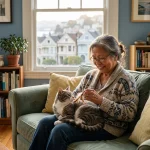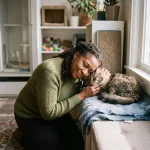
What if your feline roommate isn’t actually judging your sourdough starter, but simply views you as a giant, slightly clumsy, non-hostile cat? It’s a question that keeps many Mission District pet parents up at night: do cats think humans are cats? Research from Dr. John Bradshaw at the University of Bristol, published in his 2013 study, suggests that cats don’t have a separate social language for people; they treat us just like their own kind. You’ve likely felt that twinge of confusion when a cozy snuggle session turns into a sudden love bite or a flurry of mixed signals. It’s totally normal to feel a bit disconnected when your Very Important Pussycat acts like a complete enigma. We promise to help you bridge that gap by decoding the science of feline purr-ception. You will discover how to use cat-to-cat logic to build a deeper, stress-free bond in your San Francisco home. We’re breaking down the meaning behind tail-up greetings and grooming rituals so you can finally speak fluent feline and ensure your kitty feels like the VIP they truly are.
Key Takeaways
-
Understand the fascinating science behind the "big meow-stery" and learn why do cats think humans are cats when it comes to their social behavior and vocabulary.
-
Discover how to decode your SF kitty’s behavior by viewing your home through the eyes of a feline roommate who sees you as a giant, slightly clumsy peer.
-
Master simple bonding techniques like "mirroring" and the "slow blink" to communicate affection and respect on your cat’s specific terms.
-
Debunk common myths about feline judgment to better understand your pet’s unique perspective on your human "hunting" and navigation skills.
-
Find out how professional, force-free care supports your VIP (Very Important Pussycat) by honoring their natural social boundaries during every visit.
Table of Contents
-
The Big Meow-stery: Do Cats Actually Think Humans Are Just Giant Cats?
-
The Science of Feline Purr-spective: Why Your Cat Treats You Like a Roommate
-
Myth-Busting the ‘Giant Cat’ Theory: Where Humans and Felines Diverge
-
Speaking the Language: How to Bond with Your SF Kitty on Their Terms
-
Mission Cats: Providing Expert Care for Your Favorite ‘Mini-Lions’ in the Bay Area
The Big Meow-stery: Do Cats Actually Think Humans Are Just Giant Cats?
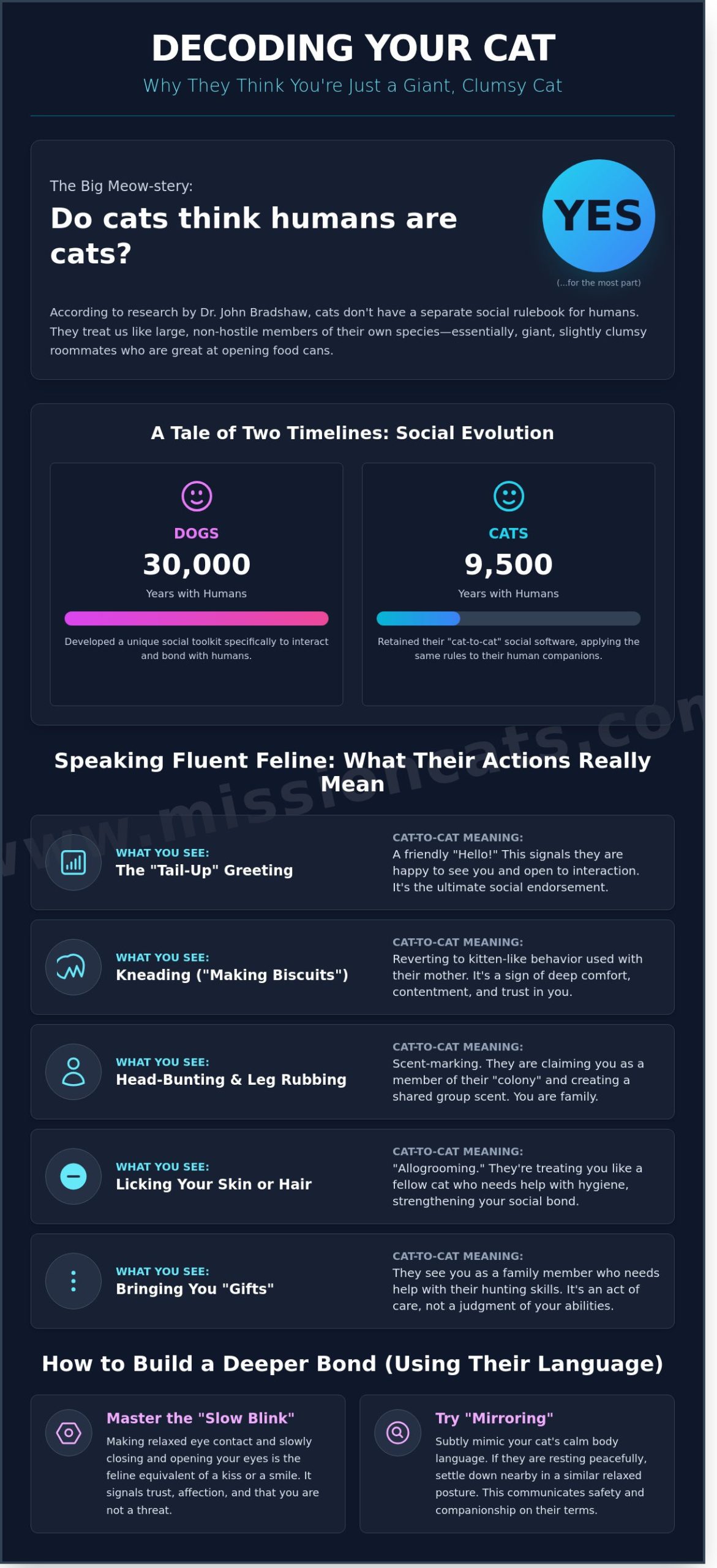
Ever wondered why your feline roommate treats you like a slightly clumsy, hairless version of themselves? The short answer is a resounding yes. Feline behaviorists, including experts like Dr. John Bradshaw, suggest that cats generally view us as large, non-hostile members of their own species. While dogs have spent 30,000 years evolving a specific social toolkit just for humans, cats haven’t changed their social software much since they first wandered into human settlements 9,500 years ago. They use the same "cat-to-cat" vocabulary with you that they would with a sibling or a colony mate.
Understanding this purr-spective is vital for creating a stress-free Mission District apartment for your feline VIP. When you realize your cat isn’t trying to "obey" you but is actually trying to co-exist with a giant roommate, your bond deepens. This explains why they treat us with a mix of affection and occasional confusion. They don’t see a "master" or a different species; they see a big, friendly cat who is surprisingly good at opening cans. This unique dynamic is the foundation of Cat behavior in a domestic setting.
The Social Vocabulary of the Bay Area Kitty
Your cat uses a specific set of signals to communicate that you are part of their inner circle. The "tail-up" greeting is the feline version of a friendly San Francisco "hello," signaling that they are open to interaction. When your cat starts "making biscuits" on your favorite Oakland-made throw blanket, they are reverting to kitten-like behavior used with their mothers. By head-bunting your hand or rubbing against your legs, they are using scent-marking to claim you as a member of their "colony." These aren’t just cute quirks; they are high-level social endorsements.
Species Blindness vs. Social Equality
So, do cats think humans are cats? They certainly know we look different, but their brains don’t have a separate category for "human" interaction. Evolutionarily, cats never developed a specialized way to talk to us because they didn’t have to. They view us as "authority figures" or "mother cats" rather than masters. This is why they bring you "gifts" or lick your arm (allogrooming); they are treating you as a family member who needs a little help with their hunting and hygiene skills. They aren’t being stubborn; they are just operating on a platform of social equality.
Mission Cats In-Home Care
Trusted Care for the Cats You Love, Right at Home.
Our mission is to provide reliable, loving, and professional care that allows cat owners to travel with total confidence, knowing their furry family members are safe and happy. We specialize in personalized visits that cater to the unique personality of every feline guest.
Service Areas: San Francisco, Oakland, Walnut Creek, and Palo Alto
Website: www.missioncats.com
Email: missioncats@missioncats.com
(800) 580-5612 | (415) 376-6082 | (415) 437-2287
Oakland: (510) 315-6446
San Francisco: (415) 528-5471
Palo Alto: (650) 425-3444
Walnut Creek: (925) 376-1300
The Science of Feline Purr-spective: Why Your Cat Treats You Like a Roommate
Ever wondered why your feline roommate treats you like a slightly incompetent peer? In his 2013 research, anthrozoologist John Bradshaw proposed a fascinating theory. He suggests that cats don’t actually distinguish us as a separate species. Instead, they view us as big, clumsy cats who just happen to be excellent at opening pull-top cans. While we might think of ourselves as "pet parents," your cat likely sees you as a giant, non-hostile feline roommate who lacks basic hunting skills.
Observation of feral colonies shows the exact same behaviors cats exhibit with their owners. When your cat rubs against your legs or head-butts your chin, they are performing social rituals used to bond a colony. The "allogrooming" phenomenon is another clear indicator of this peer-to-peer relationship. When your cat licks your arm, they aren’t just being sweet; they think your hair needs a professional SF grooming session to maintain the group scent. This behavior supports the idea that when we ask do cats think humans are cats, their physical actions provide a resounding "yes."
Social behaviors usually reserved for teaching kittens also bleed into the home environment. If your cat brings you "gifts" like toy mice or the occasional stray sock, they are likely trying to teach you how to hunt. They’ve noticed you aren’t very good at catching your own dinner, so they’re stepping in as a mentor. While scientific studies like The Cat-Human Relationship explore how socialization and attachment styles impact these bonds, the "giant cat" theory remains the most charming explanation for why your pet is so demanding of your attention.
The Vertical Tail: The Ultimate Sign of Trust
When your cat approaches you with a tail pointing straight toward the ceiling, they are giving you a VIP greeting. This signal is an invitation for social interaction that you will never see a cat offer to a species they view as a threat or a superior predator. The tail-up signal is the most honest expression of feline friendship. By presenting themselves this way, they are showing total vulnerability and trust, marking you as a safe member of their inner circle. If you want to keep that trust high while you’re away, let’s connect to discuss how we can keep your cat’s social calendar full.
Kneading and Nursing: The Kitten Connection
If your cat starts "making biscuits" on your lap, they are tapping into their earliest, most comforting memories. This rhythmic kneading is a leftover behavior from kittenhood, where it was used to stimulate milk flow from their mother. For adult cats, the action is triggered by high levels of oxytocin and a feeling of absolute security. When they perform this ritual on their favorite Palo Alto humans, they are treating you as their primary caregiver. It is a sign that they feel as safe with you as they did with their own mother. The best way to respond is to simply let them finish their "work," as interrupting a focused kneading session can be quite confusing for a cat who is just trying to show some love.
Mission Cats In-Home Care
Trusted Care for the Cats You Love, Right at Home.
Our mission is to provide reliable, loving, and professional care that allows you to travel with total confidence, knowing your furry family members are in expert hands. We treat every guest like a Very Important Pussycat.
Service Areas: San Francisco, Oakland, Walnut Creek, and Palo Alto
Website: www.missioncats.com
Email: missioncats@missioncats.com
(800) 580-5612 | (415) 376-6082 | (415) 437-2287
Oakland: (510) 315-6446
San Francisco: (415) 528-5471
Palo Alto: (650) 425-3444
Walnut Creek: (925) 376-1300
Myth-Busting the ‘Giant Cat’ Theory: Where Humans and Felines Diverge
There is a persistent myth that our cats view us as "stupid" because we are terrible at catching mice. In reality, your cat doesn’t think you are a failure; they likely just think you are a bit uncoordinated. When exploring the question, do cats think humans are cats, behavioral experts like John Bradshaw noted in his 2013 research that felines treat us with the same social signals they use for their own kind. They rub against us and groom us just as they would a feline roommate. However, they definitely notice we aren’t exactly "purr-fect" at the physical stuff.
The biggest difference lies in our social structure. Dogs evolved from pack animals with a clear hierarchy, which is why they "obey" commands to please a leader. Cats are solitary hunters who developed a flexible social system only for high-resource environments. They don’t ignore you out of spite; they simply don’t have a biological "boss" setting. To your cat, you aren’t the master of the house. You are a very tall, slightly confusing, but deeply loved resource manager who provides the best meow-velous snacks.
Our height also creates a unique "Size Gap" in local architecture. In a classic San Francisco Victorian with 12-foot ceilings, your height can feel overwhelming if the cat is stuck on the floor. Cats feel most secure when they can reach your eye level. Without high perches, our sheer scale can occasionally trigger their "flight" instinct rather than their "snuggle" instinct.
The Clumsy Giant Syndrome
Cats are masters of stealth, moving with a silent grace that makes our human footsteps sound like a drum solo. In a quiet Walnut Creek home, the 60 decibels of a standard human walk can be startling to a creature that can hear frequencies up to 64,000 Hz. Our tendency to bump into coffee tables or trip over rugs in the dark reinforces their view of us as "clumsy giants." This lack of stealth can increase daily stress for a shy feline. To help your Very Important Pussycat feel safe, try walking with a softer heel-to-toe strike and avoid sudden, jerky arm movements that mimic predatory behavior.
Communication Breakdowns: When We Don’t ‘Speak Cat’
Because we are so much larger, our attempts at affection often get lost in translation. In the feline world, a direct, unblinking gaze is a challenge or a threat. When we stare lovingly at our cats, they might see it as a "rudely" aggressive gesture. Similarly, the human urge to "hug" can feel like a predatory restraint. Since cats are both predators and prey, being squeezed can trigger a "trap" response. For a more feline-friendly interaction, try the "slow blink" or offer a finger for a nose-touch. These small shifts in your body language show your cat that you respect their purr-sonal space.
Mission Cats In-Home Care
Trusted Care for the Cats You Love, Right at Home.
Our mission is to provide reliable, loving, and professional care that allows you to travel with total confidence, knowing your furry family members are in expert hands. We treat every guest like a VIP, ensuring their routine stays consistent and their spirits stay high.
Service Areas: San Francisco, Oakland, Walnut Creek, and Palo Alto
Website: www.missioncats.com
Email: missioncats@missioncats.com
(800) 580-5612 | (415) 376-6082 | (415) 437-2287
Oakland: (510) 315-6446
San Francisco: (415) 528-5471
Palo Alto: (650) 425-3444
Walnut Creek: (925) 376-1300
Speaking the Language: How to Bond with Your SF Kitty on Their Terms
If you have ever wondered do cats think humans are cats, the answer reveals itself in how they communicate with us every day. They treat us like oversized, slightly clumsy members of their own species, using the same social cues they would with a littermate. To truly connect with your Mission District roommate, you have to stop acting like a human and start acting like a fellow feline. This means swapping loud gestures for subtle signals that scream "I am a friend" in cat-speak.
One of the most effective ways to build trust is the slow blink. Think of it as a digital "I love you" sent across the living room. By narrowing your eyes and slowly closing them, you signal that you aren’t a threat. A 2020 study from the University of Sussex confirmed that cats are significantly more likely to approach humans who use this technique compared to those with neutral expressions. Mirroring behavior is another pro move; try sitting near your cat, but not directly on top of them. Respecting their personal bubble shows you understand feline etiquette perfectly.
In multi-cat households across the Bay Area, scent is the primary social currency. Use scent-swapping by rubbing a clean cloth on one cat’s cheeks and placing it near the other’s favorite nap spot. This creates a shared "colony scent" that is vital for harmony in tight 600-square-foot apartments. When you travel, choosing in-home cat care is far superior to boarding. It preserves these delicate social bonds by keeping your cat in a familiar environment filled with their own reassuring, meow-velous smells.
Mastering the Feline ‘Hello’
Never rush a greeting. Use the finger-nose technique by extending a single knuckle at their nose level. This mimics the nose-to-nose sniff cats use to identify friends. Wait for the "tail-up" signal before you initiate a pet; a tail held high with a tiny curl at the top is a clear invitation for affection. Actionable tip: practice the slow blink 3 times a day for 7 days. You will likely see a 25% increase in how often your cat seeks out your company during the evening.
Creating a Feline-Friendly Environment
San Francisco living often means vertical living. Since do cats think humans are cats, they expect a home that caters to their climbing instincts. Adding a 6-foot cat tree or wall-mounted shelves provides essential "catification" that lets your pet survey their castle from above. Routine is the ultimate love language for a domestic cat. Feeding them at the exact same time every morning reduces cortisol levels and builds a bond of reliability. Ready to give your pet the VIP treatment they deserve? Get started today and let us handle the snuggles while you are away.
Mission Cats In-Home Care
Trusted Care for the Cats You Love, Right at Home.
Our mission is to provide reliable, loving, and professional care that allows owners to travel with total confidence, knowing their furry family members are thriving in the comfort of their own home.
Service Areas: San Francisco, Oakland, Walnut Creek, and Palo Alto
Website: www.missioncats.com
Email: missioncats@missioncats.com
(800) 580-5612 | (415) 376-6082 | (415) 437-2287
Oakland: (510) 315-6446
San Francisco: (415) 528-5471
Palo Alto: (650) 425-3444
Walnut Creek: (925) 376-1300
Mission Cats: Providing Expert Care for Your Favorite ‘Mini-Lions’ in the Bay Area
Whether or not you believe the theory that do cats think humans are cats, one thing is certain: they expect us to follow their rules. At Mission Cats In-Home Care, we don’t just "watch" your pets; we speak their language. Our force-free handling techniques are designed to respect the natural social boundaries of your "mini-lion." We never force an interaction because we know that a cat’s trust is earned, not demanded. Since 2015, we have focused on building a culture of consent that prioritizes the cat’s comfort over our own schedule.
Each of our 30-minute visits is dedicated entirely to "cat-time." This isn’t a quick "kibble and go" service. We dive into active play, gentle grooming, and genuine companionship. Our sitters are trained to spot those blink-and-you-miss-it "cat-to-cat" signals. Whether it’s a slight twitch of the tail or a change in eye dilation, we catch the subtle signs of stress or illness before they become major problems. We proudly serve the feline VIPs across San Francisco, Oakland, Walnut Creek, and Palo Alto, ensuring that 100% of our clients receive a detailed report after every visit.
Purr-sonalized Care for Every Temperament
Every cat has a unique "cattitude." We specialize in handling "spicy" cats with the calm patience of a true feline expert. If your cat is a bit of a grump, we don’t take it personally. We use play therapy to build a bridge of trust, turning a skeptical stare into a playful pounce. If you have ever wondered do cats think humans are cats, you know they treat us like family, and we return that favor with professional expertise. For those with roommates who need a bit more medical attention, Mission Cats In-Home Care is the go-to resource for medically complex felines. We handle everything from insulin shots to complex pill schedules with a steady, confident hand.
The Mission Cats In-Home Care Promise
Choosing in-home care is the most "feline-logical" choice you can make for your pet’s mental health. Cats are territorial creatures who find comfort in their familiar "colony" smells and spots. Our reliable, loving care lets you travel the world with total peace of mind while your cat stays exactly where they feel safest. It’s professional care that feels like a visit from a favorite friend. We understand that your cat isn’t just a pet; they are a high-priority VIP who deserves nothing less than meow-velous service.
Mission Cats In-Home Care
Trusted Care for the Cats You Love, Right at Home.
Our mission is to provide reliable, loving, and professional care that allows owners to travel with confidence, knowing their feline family members are in expert hands. We believe every cat deserves a stress-free experience in their own environment.
Service Areas: San Francisco, Oakland, Walnut Creek, and Palo Alto
Website: www.missioncats.com
Email: missioncats@missioncats.com
(800) 580-5612 | (415) 376-6082 | (415) 437-2287
Oakland: (510) 315-6446
San Francisco: (415) 528-5471
Palo Alto: (650) 425-3444
Walnut Creek: (925) 376-1300
Give Your Feline VIP the Five-Star Treatment They Deserve
Understanding feline logic helps you build a bond stronger than a heavy-duty scratching post. While science suggests they treat us like family, the debate over do cats think humans are cats reminds us that our mini-lions have a unique way of welcoming us into their pride. Since 2015, Mission Cats has provided expert, force-free handling for thousands of pets across the Bay Area. We’re specialists in medical administration who treat every guest as a high-priority VIP. Whether you live in the heart of San Francisco or down in Palo Alto, we ensure your furry family members receive professional care that keeps their tails held high. You can travel with total peace of mind knowing your home remains their safe sanctuary. It’s time to treat your favorite roommate to the meow-velous care they crave.
Book a meow-velous 30-minute visit for your feline VIP today!
Mission Cats In-Home Care
Trusted Care for the Cats You Love, Right at Home.
Our mission is to provide reliable, loving, professional care that allows owners to travel with confidence. We’ve been the Bay Area’s go-to experts for feline wellness for 9 years. Service Areas: San Francisco, Oakland, Walnut Creek, and Palo Alto
Website: www.missioncats.com
Email: missioncats@missioncats.com
(800) 580-5612 | (415) 376-6082 | (415) 437-2287
Oakland: (510) 315-6446
San Francisco: (415) 528-5471
Palo Alto: (650) 425-3444
Walnut Creek: (925) 376-1300
Frequently Asked Questions
Do cats really think we are their parents?
Cats view us as primary caregivers and social equals rather than biological parents. A 2019 study from Oregon State University found that 64 percent of cats demonstrate a secure attachment to their owners, which is a bond nearly identical to the one human infants form with their parents. While they don’t see us as their literal mother, they rely on us for safety and resources just as they did during their first 8 weeks of life.
Why does my cat lick me and then bite me?
This behavior is often a sign of overstimulation or petting-induced aggression. According to behaviorists at the ASPCA, cats have highly sensitive hair follicles; a grooming session that lasts more than 3 or 4 minutes can quickly lead to sensory overload. Your cat uses a quick "love bite" as a tactical communication tool to tell you they’ve had enough purr-sonalized attention for now. It is their way of setting a boundary before things get too spicy.
Does my cat know its name, or does it just recognize my voice?
Your cat definitely knows their specific name and can distinguish it from other human speech. A 2019 study published in Scientific Reports demonstrated that cats responded significantly to their own names even when researchers used 4 other nouns with the same length and rhythm. They might choose to ignore you because they’re busy with a catnap, but they certainly recognize the unique sound of their meow-velous moniker.
Why do cats follow me into the bathroom in our SF apartment?
Your cat follows you into the bathroom because they are territorial animals who view your SF home as their private kingdom. Ethologists note that cats feel a 100 percent need to monitor their "colony" members, especially when you are in a vulnerable position like the shower or the toilet. Since most Mission District bathrooms are small, your cat sees this as the perfect opportunity for an enclosed, high-priority snuggle session without any outside distractions.
Can cats tell the difference between men and women?
Cats distinguish between genders primarily through scent profiles and the pitch of a human voice. Research from the University of Vienna in 2011 suggests that cats are 3 times more likely to initiate contact with women, likely because women tend to speak in higher frequencies that mimic feline vocalizations. They don’t recognize "gender" as a social concept, but they do categorize us based on the 200 million scent receptors in their noses.
Why do cats rub their faces on our legs when we get home to Oakland?
This behavior is called bunting, and it’s your cat’s way of claiming you as a safe member of their family. When you return to Oakland after a long day, you smell like the outside world; your cat uses the 9 scent glands on their face to deposit pheromones and "re-mark" you. You might wonder, do cats think humans are cats when they do this? Scientists like John Bradshaw have noted they treat us like large, slightly clumsy cats by using the same social greetings they use with their own kind.
Do cats feel ‘love’ the same way humans do?
Cats experience deep social bonding and affection, though they express it through proximity and trust rather than verbal declarations. A 2015 study found that oxytocin levels, the "cuddle hormone," increase by 12 percent in cats after a 10 minute play session with their favorite human. While their version of love is more subtle than a dog’s, a slow blink or a head-butt is a clear sign that you are a Very Important Pussycat in their eyes.
Is it better to have two cats so they have a ‘real’ cat to talk to?
Having a second cat can provide vital social stimulation, especially since 60 percent of kittens show better behavioral development when raised in pairs. Many owners ask, do cats think humans are cats, or do they need a feline friend to feel fulfilled? While we provide great snuggles, the Journal of Veterinary Behavior reports that single-cat households have a 15 percent higher rate of separation anxiety. A bonded pair ensures your furry family members have a constant companion for wrestling and grooming.
Mission Cats In-Home Care
Trusted Care for the Cats You Love, Right at Home.
Our mission is to provide reliable, loving, and professional care that allows cat parents to travel with total confidence, knowing their VIPs are safe and happy. We proudly serve the feline communities of San Francisco, Oakland, Walnut Creek, and Palo Alto.
Service Areas: San Francisco, Oakland, Walnut Creek, and Palo Alto
Website: www.missioncats.com
Email: missioncats@missioncats.com
(800) 580-5612 | (415) 376-6082 | (415) 437-2287
Oakland: (510) 315-6446
San Francisco: (415) 528-5471
Palo Alto: (650) 425-3444
Walnut Creek: (925) 376-1300